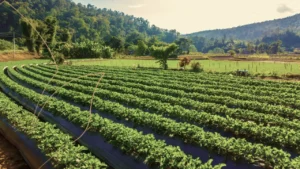
Plantations for sale in Karnataka span coffee, pepper, cardamom, rubber, and arecanut estates, each with different pricing, regions, yields, and ownership realities. The state’s Western Ghats and coastal belts hold most of the country’s premium coffee and arecanut acreage, with listings ranging from 5-acre rubber plots near Mangalore to 240-acre coffee estates near Chikkamagalur. This guide compares the five main types, walks through the post-2020 legal process, and surfaces a third path most classifieds won’t tell you about.
Types of Plantations Available For Sale in Karnataka
Karnataka’s plantation economy isn’t one product. It’s five categories, each in different regions, at different price points, with different income profiles. Here’s the matrix collapsed.
Coffee Plantations (Arabica & Robusta)
Coffee is Karnataka’s flagship plantation crop. Sakleshpur, Chikkamagalur, Coorg, and Mudigere produce the majority of India’s coffee. A typical acre carries 1,200 to 1,400 plants. Arabica yields 350 to 500 kg of clean beans per acre; Robusta runs higher at 600 to 900 kg. Establishment cost is around ₹60,000 to ₹75,000 per acre, and pepper intercrops on the shade trees for a second income stream. Our deeper dive on coffee estates in Sakleshpur covers the regional comparison.
Pepper Plantations
Standalone pepper plantations are uncommon. Pepper is almost always intercropped with coffee or arecanut, which is why it rarely shows up as a separate listing. The crop has strong domestic demand and a healthy export market. The smaller acreages that exist sit mostly in the Hassan-Chikkamagalur belt. For most buyers, pepper is an income layer added to a coffee estate, not a buying decision on its own.
Cardamom Plantations
Cardamom in Karnataka is rare. Kerala dominates Indian production, and Karnataka contributes a smaller share, mostly from Shimoga and pockets near the Western Ghats. Yields can deliver ₹4 to ₹6 lakh per acre in annual income potential. Listing prices range from ₹10 lakh to ₹70 lakh per acre depending on age and location. Establishment runs ₹1 to ₹1.5 lakh per acre. The catch is drought sensitivity. A bad rainfall year hits cardamom harder than coffee or arecanut.
Rubber Plantations
Rubber concentrates in Dakshina Kannada and Udupi, often in mixed estates with arecanut. The economics are slow. Trees take roughly seven years to mature before tapping begins, so a fresh rubber plantation is a long-horizon hold rather than a day-one income asset. Most rubber acreage in Karnataka is sold as part of mixed-crop estates rather than pure rubber blocks.
Arecanut Plantations
Karnataka leads India in arecanut production. Shivamogga, Uttara Kannada, and Dakshina Kannada are the heartland districts. Yields can reach ₹4.5 lakh per acre per year on a mature estate, but the crop is water-intensive and prices are volatile. Mandi rates currently hover around ₹294 per kg on average. Establishment cost lands near ₹1.46 lakh per acre, with a six- to eight-year break-even.
Verdict for the broad-search buyer: Among Karnataka plantation types, coffee with pepper intercrop in Sakleshpur delivers the most balanced profile for first-time buyers. You get dual income from two crops, established export markets via the Coffee Board of India, moderate water requirements compared to arecanut, and weekend accessibility from Bangalore at a four-hour drive. Coffee plus pepper intercrop is the closest thing to dual income from one acre, and the rest of this guide shows why.
By Location: Where Plantations Are Sold in Karnataka
Where the plantation sits matters as much as what grows on it. Each Karnataka belt has a crop personality, a price band, and a connectivity profile.
• Sakleshpur, Mudigere, Belur (Hassan district): Coffee, pepper, and mixed estates. The closest premium coffee belt to Bangalore.
• Chikkamagalur: Arabica heartland, with pockets of cardamom and high-altitude estates.
• Coorg / Madikeri: Coffee plus a strong farm-stay overlay; tourism revenue layered on top of crop income.
• Shivamogga, Sagar: Arecanut belt, with cardamom in select pockets.
• Uttara Kannada, Dakshina Kannada: Arecanut, rubber, and cashew along the coast.
Sakleshpur sits four hours from Bangalore by road, which makes it the only Western Ghats coffee region inside a comfortable weekend reach. That single fact narrows the field for most Bangalore-based buyers. If proximity is the constraint, take a closer look at managed farmland near Bangalore
Plantation Pricing Per Acre: What Each Type Costs
Coffee plantations in Sakleshpur, Chikmagalur, and Coorg typically sell for ₹15 to ₹30 lakh per acre when established. Cardamom estates range from ₹10 to ₹70 lakh per acre. Arecanut plantations in Shivamogga list between ₹15 and ₹50 lakh per acre. Pricing depends on tree maturity, water access, and road connectivity.
Indicative ranges by category, drawn from current listings and recent transactions:
• Coffee plantation (established): ₹15 to ₹30 lakh per acre. Coorg trends toward the upper band (₹24 lakh seen recently); Chikmagalur opens lower around ₹15 lakh.
• Cardamom plantation: ₹10 to ₹70 lakh per acre. Most Karnataka cardamom listings sit in the ₹10 to ₹25 lakh range; the upper band reflects mature, well-irrigated estates.
• Arecanut plantation: ₹15 to ₹50 lakh per acre, varying with tree age and water source.
• Rubber + arecanut mixed (Dakshina Kannada / Udupi): ₹20 to ₹40 lakh per acre.
• Raw agricultural land in Sakleshpur: ₹15 lakh per acre and up. Bare land is the lowest entry point but carries the highest development burden.
Three caveats. First, listing prices are highly location and condition-dependent. A Coorg estate fronting a tar road prices very differently from a similar acreage off a kachha trail. Second, yield economics matter more than acquisition cost. A ₹20 lakh estate that throws ₹1.5 lakh in net annual income beats a ₹12 lakh estate that throws ₹40,000. Third, bare land, an established plantation, and a managed estate are three different products. For more granularity on Sakleshpur specifically, land prices in Sakleshpur breaks out the Hassan-district variation.
Looking specifically at coffee? See coffee estates for sale in Sakleshpur for the curated short-list and current pricing.
Legal Process: How to Buy a Plantation in Karnataka (Post-2020 Reforms)
Karnataka deleted Section 79A in 2020. Anyone with any income can now buy a plantation. That single change rewrote who can own agricultural and plantation land in this state, and most listings haven’t caught up to what it means.
Buying a plantation in Karnataka after the 2020 Land Reforms Amendment is open to non-agriculturists and high-income buyers. Section 79A was nullified and Section 79B was repealed. Section 103 exempts plantation properties from the 108-acre dry-land ceiling. Buyers must verify title deed, RTC, encumbrance certificate, and survey records before registration.
What changed:
• Pre-2020: Section 79A capped non-agricultural income at ₹25 lakh for buyers of agricultural land. Section 79B blocked companies and non-agriculturists outright.
• 2020 Amendment: Section 79A nullified. Section 79B repealed. Anyone, regardless of income source, can now purchase plantation property.
• Section 103 (still in force): Exempts plantation properties from the dry-land ceiling. Dry land is capped at 108 acres after the 2020 amendment, but coffee, tea, rubber, and other plantations face no such cap. Large legacy estates remain unrestricted.
Documents to verify before any plantation purchase: title deed, RTC (Record of Rights, Tenancy and Crops), Mutation, Encumbrance Certificate, Survey sketch, Akarband, Khata, and any required NOC. Boundary survey and revenue records should be cross-checked before registration; this is where most disputes originate. For a wider primer across all agricultural-land categories, the guide on buying agricultural land in Karnataka covers the broader process.
The Managed Option: A Cleaner Path Than Direct Purchase
Direct purchase of a plantation transfers full operational responsibility, labor, pest management, crop sale, legal compliance, to the buyer. A managed plantation transfers these functions to a management company in exchange for a higher entry cost, making it suitable for non-resident buyers, NRIs, and professionals with limited site time.
Two paths, two burden structures:
• Direct purchase: Lowest acquisition cost. Highest operational burden. You handle labor, pest control, crop sale, weather risk, security, and ongoing legal compliance. Works for buyers who can travel often and have bandwidth to manage labor and crop logistics.
• Managed plantation: Higher entry cost. Operational burden transferred to a management company. Predictable economics. Tier-of-amenity access. Suits NRIs, busy professionals, and anyone whose time on-site is measured in weekends per year, not weeks per month.
Direct gives you control. Managed gives you peace of mind. The answer depends on how much of your own time you can put into the asset. For a deeper look at what the managed model delivers, walks through the operational structure.
KAIRA: Managed Coffee Estate in Sakleshpur by Vibez Estates
Kaira by Vibez Estates is a 40-acre contiguous managed coffee estate in Sakleshpur, built for buyers who want the coffee-plus-pepper income profile without the operational burden. The estate runs on a Three Paths ownership model:
• Tier 1 Managed Plots: From 6,500 sqft and up. Built for entry investors who want a foothold in a managed coffee estate without committing to a villa or a legacy holding.
• Tier 2 Villa Plots: 3,500 to 8,000 sqft. Lifestyle buyers, weekend homes inside a working coffee estate.
• Tier 3 Legacy Estates: 30,000 sqft. HNI tier, for buyers building a multi-generational holding.
Anchor amenities include a 5-star resort, a biophilic pond at the centre of the masterplan, vernacular architecture across the built form, and a 300-strong investor community. Trust signals are concrete: 100% clear titles, 40 contiguous acres, 300+ investors already on board, and Phase 1 at 35% sold. KAIRA sits within Vibez Estates’ 16+ project track record since 2009 under founder Ashwin Kumar. The brand line, Roots for your Legacy. Returns for your Future, is the working frame for how the estate is built and sold.
For a managed coffee estate with clear titles and the Three Paths option, explore KAIRA in Sakleshpur
Frequently Asked Questions
What types of plantations are available for sale in Karnataka?
Five main types: coffee, pepper, cardamom, rubber, and arecanut. Coffee dominates Sakleshpur, Chikkamagalur, and Coorg. Arecanut concentrates in Shivamogga and coastal Karnataka. Cardamom is rare in the state, with Kerala leading production. Pepper is usually intercropped with coffee or arecanut rather than sold as a standalone plantation.
How much does a plantation cost per acre in Karnataka?
Established coffee plantations in Sakleshpur, Chikmagalur, and Coorg sell for ₹15 to ₹30 lakh per acre. Cardamom estates list between ₹10 and ₹70 lakh per acre. Arecanut plantations fall in the ₹15 to ₹50 lakh per acre range. Pricing depends on tree age, water access, and road connectivity.
Can a non-agriculturist buy a plantation in Karnataka?
Yes. The 2020 Karnataka Land Reforms Amendment nullified Section 79A and repealed Section 79B, which means anyone, regardless of non-agricultural income, can now buy plantation property in the state. Section 103 also exempts plantations from the 108-acre dry-land ceiling, so large coffee, tea, and rubber estates remain unrestricted.
Coffee, pepper, or cardamom plantation: which is the better buy?
Coffee with pepper intercrop in Sakleshpur typically offers the most balanced profile. You get dual income from two crops, established export markets, moderate water requirements, and weekend access from Bangalore. Cardamom can deliver higher per-acre yield potential, but it’s more drought-sensitive than coffee. For first-time buyers, coffee usually wins on risk-adjusted return.
What’s the difference between a managed plantation and direct purchase?
Direct purchase means you handle labor, crop sale, pest management, and ongoing legal compliance yourself. A managed plantation transfers those operational responsibilities to a management company in exchange for a higher entry cost. It suits non-resident buyers, NRIs, and busy professionals whose site visits are measured in weekends per year.
Plantation buying in Karnataka comes down to three choices: which crop, which region, and how much operational burden you take on. Coffee in Sakleshpur, with the managed option layered on, is the cleanest answer for most Bangalore-based buyers, and a 4-hour drive keeps the asset within reach. For a contiguous 40-acre managed coffee estate with 100% clear titles, 300+ investors already in, and the Three Paths model, explore KAIRA in Sakleshpur