Coffee Estate For Sale in Sakleshpur.
Managed Plots from 6,500 sqft.
Three Investment Paths · One 40-Acre Coffee Estate · Anchored by a 5-Star Resort
How Much Does a Coffee Estate Cost in Sakleshpur?
A coffee estate in Sakleshpur typically costs Rs 15 to Rs 25 lakh per acre for raw or unmanaged plantations, Rs 25 to Rs 45 lakh per acre for semi-managed estates, and from Rs 55 lakh per acre for fully managed gated communities with infrastructure and amenities. Managed plot products like Kaira start at 6,500 sqft, priced as a plot package. Primary cost factors are land condition, management quality, and amenity stack.
A note on units. If you’ve been searching 1 acre coffee estate price in Sakleshpur today, the directories will show Rs 15 to 55 lakh ranges that swing by condition, road access, and water source. Kaira intentionally reframes scale. We sell from 6,500 sqft because that’s enough land for a meaningful coffee share, a private retreat, and a holding the average investor can actually manage. The price is set as a plot package, reflecting land, infrastructure, plantation, and access to the resort and management ecosystem. For current rate cards, ask. We don’t publish per-acre headlines because they mislead. Your cost is for a managed product, not bare land.
For a deeper read on land valuation in this belt, see our detailed Sakleshpur land pricing breakdown. It explains how Karnataka agri-land has trended at 8 to 14% CAGR (Knight Frank India Wealth Report 2024), why Sakleshpur is still under Coorg on absolute pricing, and what drives the gap.
Why Buy a Coffee Estate in Sakleshpur, Not Coorg or Chikmagalur
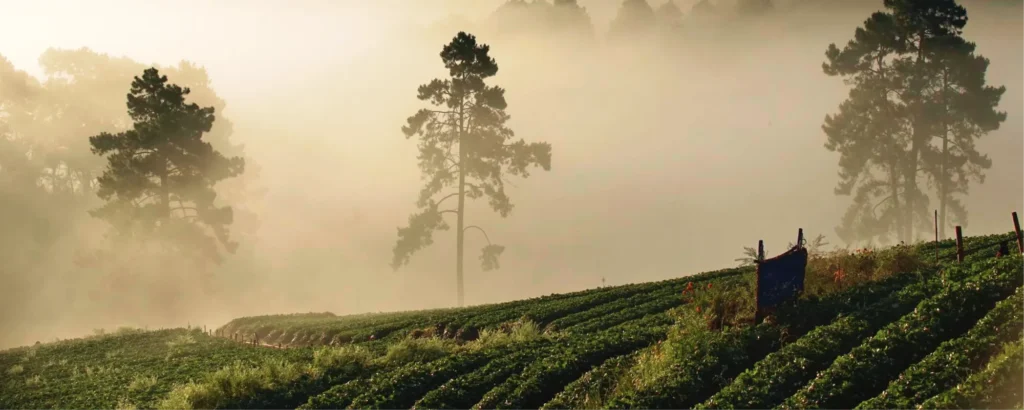
Sakleshpur and Coorg both sit in the Western Ghats and produce comparable Robusta coffee. But Sakleshpur is 4 hours from Bangalore via NH-75 versus 6 hours to Coorg. It offers lower per-acre prices in an emerging investor market, and receives 2,000 to 3,000mm of annual rainfall, supporting rain-fed cultivation without borewell dependence. Chikmagalur sits between the two on distance but commands premium Arabica pricing.
The short version: Coorg is the established address, which is why it’s priced like one. Chikmagalur is Arabica country, higher input cost, more weather-sensitive. Sakleshpur sits in the sweet spot. Close enough to Bangalore that a Friday-evening drive makes sense. Reasonable enough that the entry price for a managed plot isn’t a generational commitment. Wet enough that you’re not fighting borewells. And it’s still emerging. The asset class is being built right now, not bought from a previous owner who already captured the appreciation.
One of our buyers, after his second site visit: “I had a dream of overcoming this hectic polluted city, spending precious family time in nature, fulfilled by Vibez.” — Kaira investor, Bengaluru.
Types of Coffee Estates For Sale in Sakleshpur
Size-wise, what’s actually on the market in Sakleshpur right now: 6,500 sqft managed plots (Kaira and a couple of newer entrants), the classic 1 acre coffee estate for sale in Sakleshpur listed on classifieds (raw or semi-managed), the 5-acre tier for serious planters, and full plantations of 20 to 40+ acres at the top end. If you’re scouting the wider belt and comparing prices, our guide to coffee estate for sale Karnataka walks through how Sakleshpur stacks up against Chikmagalur and Coorg. For unmanaged stock specifically, the plantation for sale Karnataka reference covers the listing-by-listing landscape.
| Category | Raw / Neglected | Semi-Managed | Fully Managed (Kaira) |
|---|---|---|---|
| Price band | Rs 15 to 25 L / acre | Rs 25 to 45 L / acre | From Rs 55 L / acre equivalent |
| Typical size | 1 to 5 acres | 1 to 5 acres | From 6,500 sqft plot packages |
| Listings | OLX-style classifieds | Local agents, planters | Branded gated communities |
| Management | None. DIY labour | Local manager, weekly visit | Professional plantation operations |
| Amenities | None | None | Resort, clubhouse, security, roads |
| Title risk | Variable. Verify carefully | Moderate | Clean. Registered freehold |
Tier 1 · Managed Plots
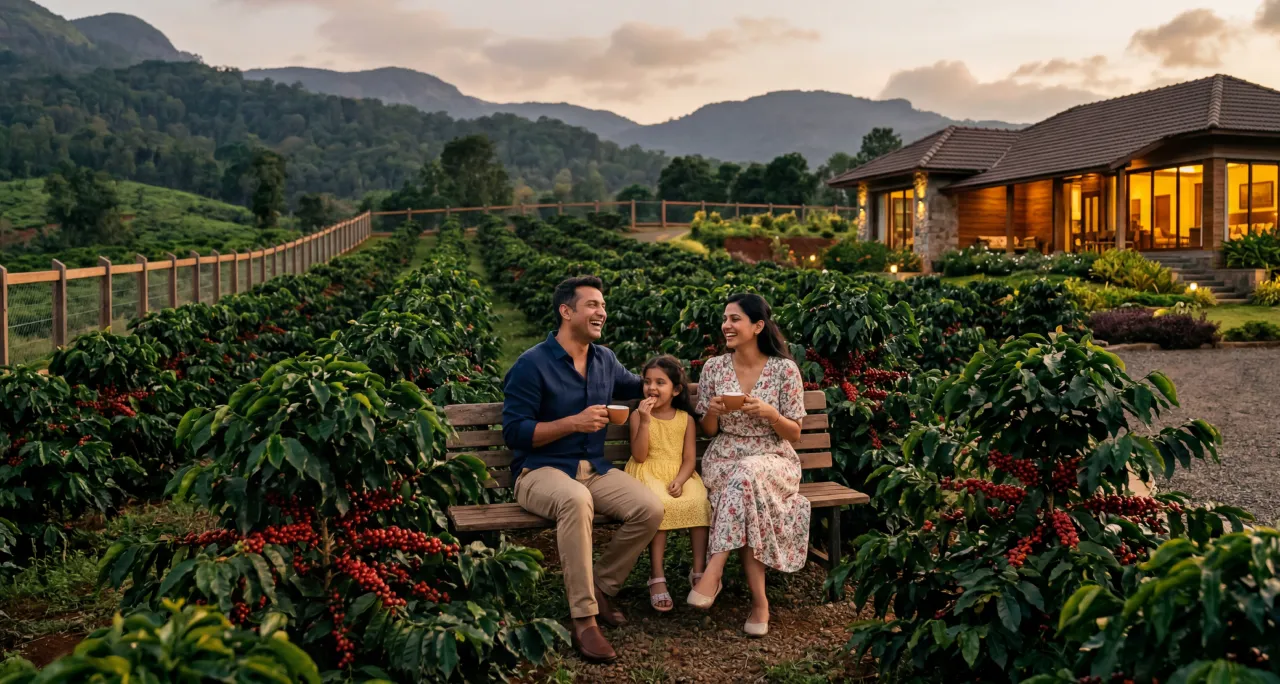
Built for the first-time managed-farmland buyer. Typically an IT or finance professional in Bangalore, 28 to 40, looking to diversify out of mutual funds into a tangible asset that also produces something. Land is freehold, registered in your name, fully transferable. Vibez handles planting, harvest, processing, and sale to mills. You receive a revenue share on the coffee harvest, paid post-harvest annually.
What's on the plot
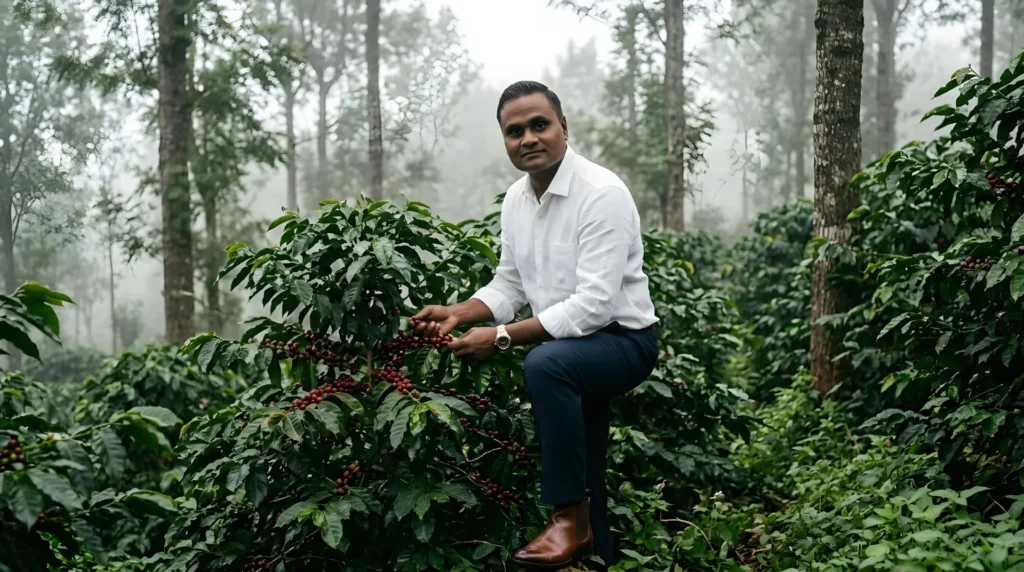
Shade-grown Robusta and Arabica coffee under silver oak canopy, the way Western Ghats coffee has been grown for a century. Black pepper vines climb the silver oaks. Professional plantation operations handled by Vibez throughout the year.
What's around the plot
The entire estate. Gated community, 24×7 security, internal roads, drainage, dedicated water sourcing. Full resort access for your weekend visits. Plantation trails through your own estate. For the alternative crop view, see our comparison on sandalwood vs coffee farmland.
Tier 2 · Villa Plots
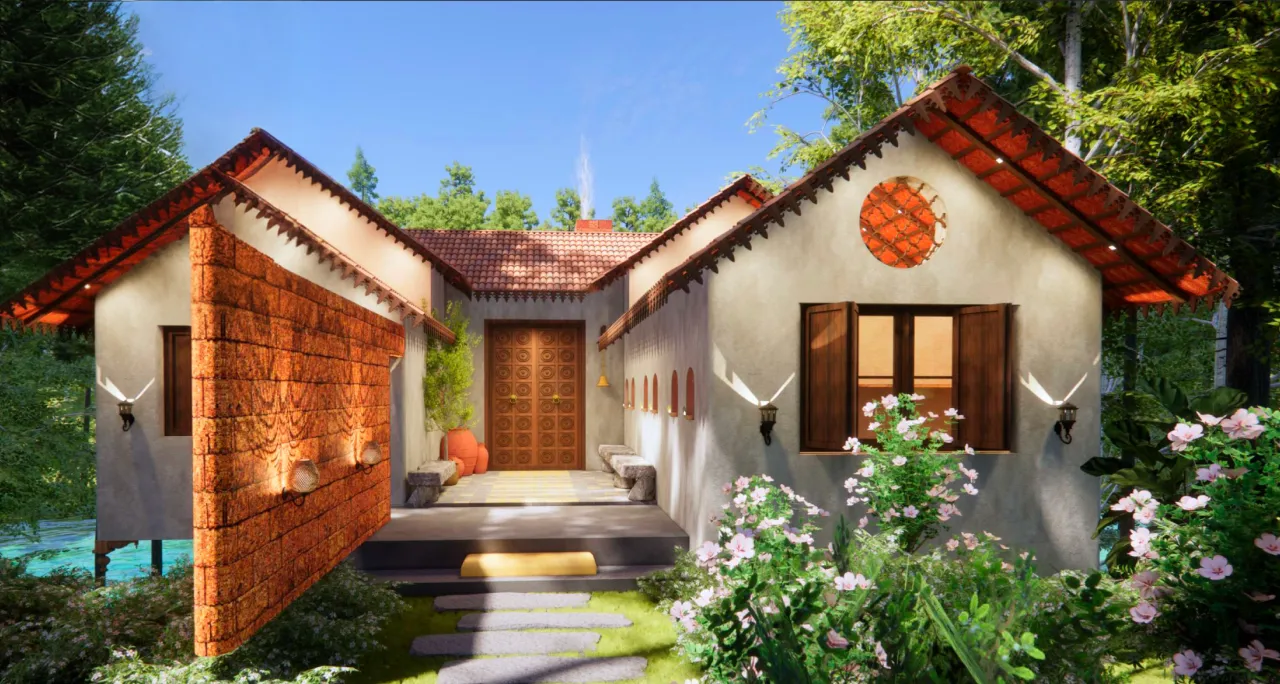
Built for senior professionals and NRIs (35 to 50, Rs 40 LPA+) who want a weekend home that also produces. Karnataka agricultural land rules permit construction up to 10% of plot area; Tier 2 designs sit within that ceiling. Build-ready plans approved. You select the design.
Construction options
1BHK, 2BHK, and Duplex villa designs. Vernacular Karnataka architecture: terracotta tile roofs, laterite stone walls, locally-sourced timber. Design references to traditional Malenadu courtyard homes. Tier 1 management still applies: coffee revenue share, professional operations. The villa is your private addition on top of that.
Built for
The buyer who comes to Sakleshpur 8 to 12 weekends a year. Wants their own walls, their own kitchen, their own veranda overlooking the plantation, with the entire estate community around them.
Tier 3 · Legacy Estates
30,000 sqft. The HNI path.
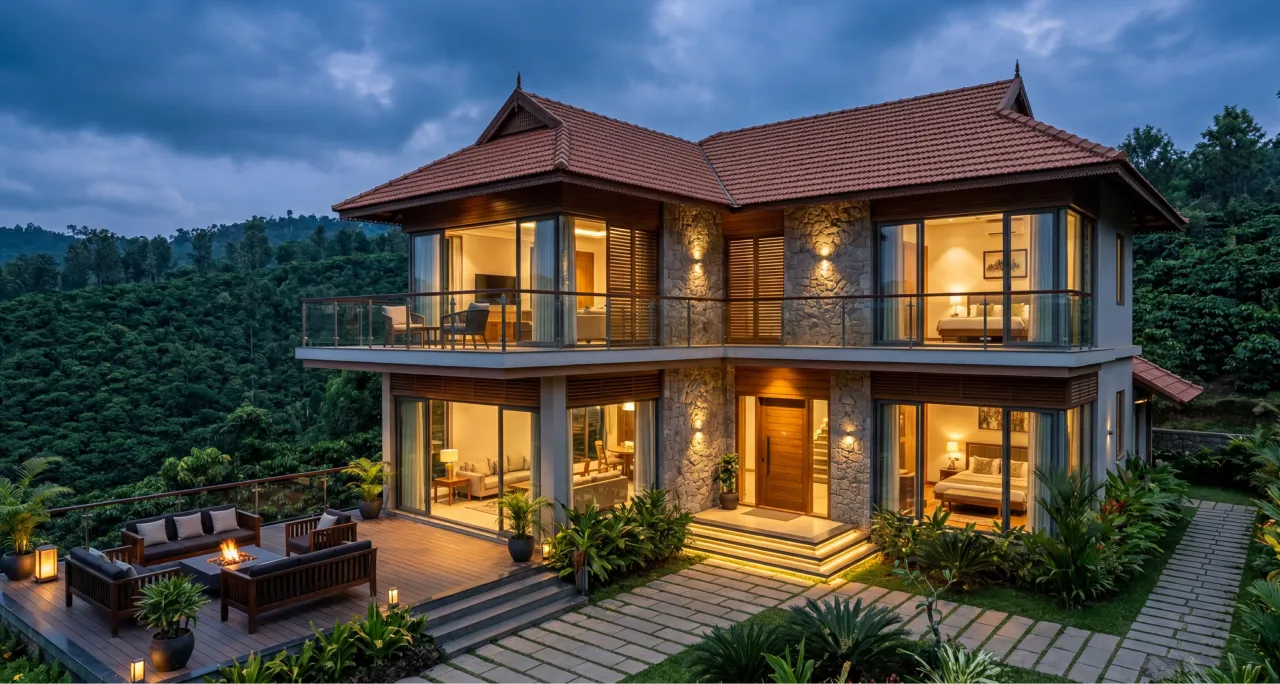
Built for serial investors and family offices (45 to 65, Rs 2 crore-plus annual income). For these buyers managed farmland is one allocation among many. The deciding criteria are scale, named principal accountability, and ROI clarity.
What it includes
A 30,000 sqft estate-scale plot inside the same 40-acre community. Vernacular bungalow construction included. Full estate amenities access. A larger plantation share. Direct relationship with Ashwin Kumar and the Vibez senior team, not call-centre escalations.
Returns positioning
Tier 3 Legacy Estates is built for buyers with a longer horizon. It comes with a larger plantation share and management terms specific to this tier, so its return profile differs from Tier 1 and Tier 2. Returns depend on land appreciation, coffee yields and market prices, and are not guaranteed. Speak to our team for a Tier 3 projection based on your plot size and holding period.
5-Star Resort, Biophilic Living
Biophilic pond at the centre of the estate, with vernacular Malenadu pavilions drawing on local building traditions. The pond cools the microclimate, supports local biodiversity, and anchors the estate’s design language. Vernacular Karnataka architecture throughout: terracotta tile roofs, laterite stone walls, locally-sourced timber. Not Tuscan, not Bali, not generic luxury-villa template. Built from the place, for the place.
Three Channels: Appreciation + Yield + Tax
Land Appreciation
Karnataka agricultural land has trended at 8 to 14% CAGR per the Knight Frank India Wealth Report 2024. Within Karnataka, Sakleshpur sits under Coorg and parts of Chikmagalur on absolute pricing, which is the appreciation runway.
8 to 14% CAGRCoffee Yield Revenue Share
Karnataka's Robusta yield averages 1,269 kg per hectare (~514 kg per acre) per Coffee Board India. Kaira runs a revenue-share structure: a portion to the estate plot owner, a portion to Vibez for operations. Paid post-harvest annually.
1,269 kg/haTax Efficiency
Under Section 10(1) of the Income Tax Act, agricultural income is exempt. Coffee follows Rule 7B, the 75/25 split. For a 30%-bracket holder, that caps the tax drag at ~7.5% on gross coffee income.
~7.5% tax dragManaged vs Unmanaged Coffee Estates

Here’s the six-axis difference between a raw plantation and a managed estate like Kaira. A managed coffee estate has professional plantation operations, transparent operating cost (typically ~Rs 35,000/acre/year), baseline yield expectations, gated community infrastructure, and registered freehold titles. An unmanaged estate is land you operate yourself. Variable yield, DIY labour, no shared amenities, and resale dependent on finding another planter buyer. The price gap reflects the operational, infrastructure, and liquidity differences.
What if Vibez ever exits the project? It’s the question every buyer asks at some point, and it should be asked. Your land, your name, forever. The sale deed is registered in your name as freehold property. That ownership is independent of who manages the estate. Management is a service layer sitting on top of your title, not a condition of it. Worst-case scenario, you have land in a gated community with infrastructure already built and a market that exists for it. Vibez Estates has been around since 2009 across 16 projects, so the worst case is hypothetical, but the structure is built to make it survivable either way.
Legal Checklist Before You Buy a Coffee Estate in Karnataka
Five things to verify before you sign anything.
- Title chain — go 30 years back. The mother deed plus 30-year ownership tracing. Most disputes come from gaps in this chain. For Kaira plots, this is done; you receive the documentation pack.
- Encumbrance Certificate (EC) — last 15 years. Pull the EC from the sub-registrar to confirm no mortgages, court attachments, or undisclosed claims.
- Karnataka 2020 amendment. Any Indian citizen can buy agri land in Karnataka post-2020. No farmer certificate, no domicile restriction.
- Sale deed registration. Stamp duty plus registration charges. Done at the sub-registrar’s office. Vibez handles the documentation and accompanies you for execution. Title is registered in your name.
- For NRIs, route via SPV or resident relative. FEMA does restrict direct NRI purchase of agricultural land. Two clean routes exist: (a) purchase through an Indian SPV or company in which you hold ownership, (b) purchase by a resident Indian relative with a separate gift/trust structure. Vibez has handled NRI transactions across 16 projects.
“Titles verified by my advocate.”Kaira investor, after independent legal review
For the full ground-up walkthrough on land purchase in this state, our how to buy land in Karnataka guide is the deeper reference.
300+ Investors. Phase 1 at 35% Sold.
300+ investors. One 40-acre estate. That concentration is the data point most directly relevant to the question buyers ask after “is it safe?”. The question about who else has actually bought. Three hundred-plus families have written cheques and registered titles inside this one estate. Phase 1 is 35% sold. That’s an honest scarcity signal, published because it’s true, not because it’s a sales tactic.
“I had a dream of overcoming this hectic polluted city, spending precious family time in nature, fulfilled by Vibez.”Kaira investor, Bengaluru
Why concentration matters for resale. A 40-acre estate with 300+ owners forms its own internal resale market. When an investor exits, the buyer often comes from within the community: friend, family, neighbour. That’s the structural answer to the “farmland is illiquid” objection. Reviews back this up too. 4.5 stars across 398 verified reviews, 178 on Google and 220 on Justdial. Independent client-satisfaction survey: 92%.
16 Years. 16 Projects. 1,000+ Customers.
Vibez Estates was founded in 2009 and has spent the last sixteen years building managed farmland and second-home estates across Karnataka. Sixteen completed or active projects. Over 1,000 customers across the portfolio. Four industry awards along the way: Indira Priyadarshini (2013), Business Excellence (2015), Best Eco-Homes (2018), Times Business (2020).
“Land owned by you, managed by us. That's the principle the entire estate is built on.”Ashwin Kumar, Founder & MD, Vibez Estates
Aggregated review rating: 4.5 stars across 398 verified reviews, 178 on Google, 220 on Justdial. Independent client-satisfaction survey: 92%. Named founder, Ashwin Kumar, with a 16-year operating history in this specific asset class. Not a real-estate generalist who pivoted last year, not a faceless LLP. The continuity is the reason buyers come back for second and third plots across our projects.
Frequently Asked Questions
How much does a coffee estate cost in Sakleshpur?+
What is the price of 1 acre coffee estate in Sakleshpur today?+
Are coffee estates in Sakleshpur profitable?+
Can a non-Karnataka resident buy a coffee estate in Sakleshpur?+
Can NRIs buy a coffee estate in Sakleshpur?+
What is the difference between a managed and unmanaged coffee estate?+
Is coffee estate income taxable in India?+
How far is Sakleshpur from Bangalore for a coffee estate visit?+
- Clear Titles
- 100% Hands-Off
- Free Site Visit