You’ve heard of Coorg. You’ve probably looked at Chikmagalur. Maybe you’ve even browsed a few listings in both and felt that familiar sting: the good plots are either gone or priced at 60 lakh to 1.5 crore per acre.
So here’s a question worth sitting with: why invest in Sakleshpur?
Sakleshpur in Karnataka’s Western Ghats offers coffee estate investment at 30-40% lower prices than Coorg, with 2,000-3,000mm annual rainfall supporting rain-fed cultivation. Located four hours from Bangalore via NH-75, the region supports Arabica coffee, pepper, and spice intercropping. Emerging infrastructure and branded hospitality developments position Sakleshpur as a pre-appreciation investment corridor.
This isn’t opinion. It’s a thesis built on seven data points. Each section below gives you numbers you can cross-check, compare, and use to make your own call.
7 Compelling Reasons to Invest in Sakleshpur
The Sakleshpur investment potential doesn’t rest on any single factor. It stacks. Here’s the framework:
1. Coffee heritage. 150 years of Arabica and Robusta cultivation, backed by the Coffee Board of India.
2. Climate. 2,000-3,000mm annual rainfall. Year-round temperatures between 22-26°C. Rain-fed, not borewell-dependent.
3. Proximity. Four-hour drive from Bangalore. Two hours shorter than Coorg.
4. Infrastructure. NH-75 four-laning completed November 2025. Shiradi Ghat restoration done July 2025.
5. Tourism momentum. 15 lakh annual tourists. 25.5% leisure CAGR (2018-2024). JW Marriott and Dusit Devarana incoming.
6. Pricing window. Land at 30-40% below Coorg, with room to appreciate before the market matures.
7. Tax advantage. Agricultural income stays exempt from income tax under Section 10(1).
Each reason gets its own section below. But the thesis in one sentence: Sakleshpur is where Coorg was fifteen years ago, except the road is better and the price of entry is a fraction of what Coorg commands today.
Coffee Heritage – 150 Years of Plantation Economics
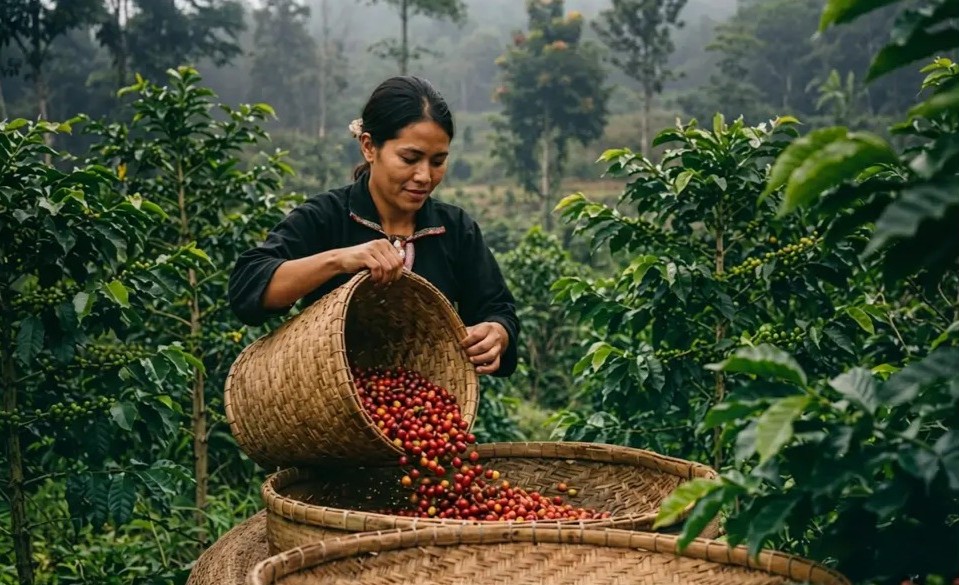
Coffee cultivation in Sakleshpur stretches back over 150 years. Both Arabica and Robusta varieties grow here, and the region’s rain-fed agriculture means growers don’t depend on borewells or canal irrigation.
That’s a structural advantage. Drier corridors east of the Ghats face dropping water tables. Sakleshpur doesn’t.
A well-maintained coffee estate in this belt produces roughly 1,000-1,500 kg of coffee cherries per acre per season. Add pepper and cardamom intercropping, and you’ve got multiple revenue lines from the same piece of earth. The Coffee Board of India registers estates in this region, which matters for institutional credibility and for buyers who want documented agricultural provenance.
The economics work in two directions, and most coffee estates in Sakleshpur discussions skip this dual-income angle:
You earn from the coffee harvest. And the underlying land appreciates. Avacasa’s market estimates peg land appreciation in plantation zones at 8-12% annually. So while the coffee trees produce revenue season after season, the earth beneath them quietly compounds in value.
One more thing. Agricultural income in India remains exempt from income tax under Section 10(1). The harvest revenue from your coffee and spice intercrop isn’t taxed the way salary, rental, or capital gains income would be. For Bangalore professionals in the 30% tax bracket, that exemption changes the effective return math considerably.
Climate – 2,000-3,000mm Rainfall and Year-Round Comfort
Sakleshpur sits at approximately 3,000 feet elevation in the Western Ghats, receiving 2,000-3,000mm annual rainfall. Average temperatures range from 22-26°C year-round. This microclimate supports rain-fed Arabica and Robusta coffee cultivation without irrigation dependency, unlike borewell-reliant farmland in Karnataka’s drier eastern corridors.
Seasonal breakdown:
• Summers: 25-32°C
• Monsoons: 22-26°C (comfortable, not extreme)
• Winters: 15-25°C (pleasant)
The Hemavathi river system feeds the region. Natural water bodies dot the landscape.
Why does this matter for investment?
Because water risk is land risk. Farmland projects in the Hosur corridor or near Kanakapura compete for borewells. One bad monsoon season and you’re pumping from deeper aquifers at higher costs. Sakleshpur’s Western Ghats microclimate doesn’t have that problem. The rain comes. It has come for 150 years. The coffee grows because the climate lets it.
Proximity to Bangalore – 4 Hours via NH-75
The distances, side by side:
• Bangalore to Sakleshpur: 220 km, roughly 4 hours on NH-75
• Bangalore to Coorg (Madikeri): 265 km, 5-6 hours on NH-275
• Bangalore to Chikmagalur: 245 km, about 4.5 hours on NH-73
The numbers are straightforward. But here’s what they don’t capture.
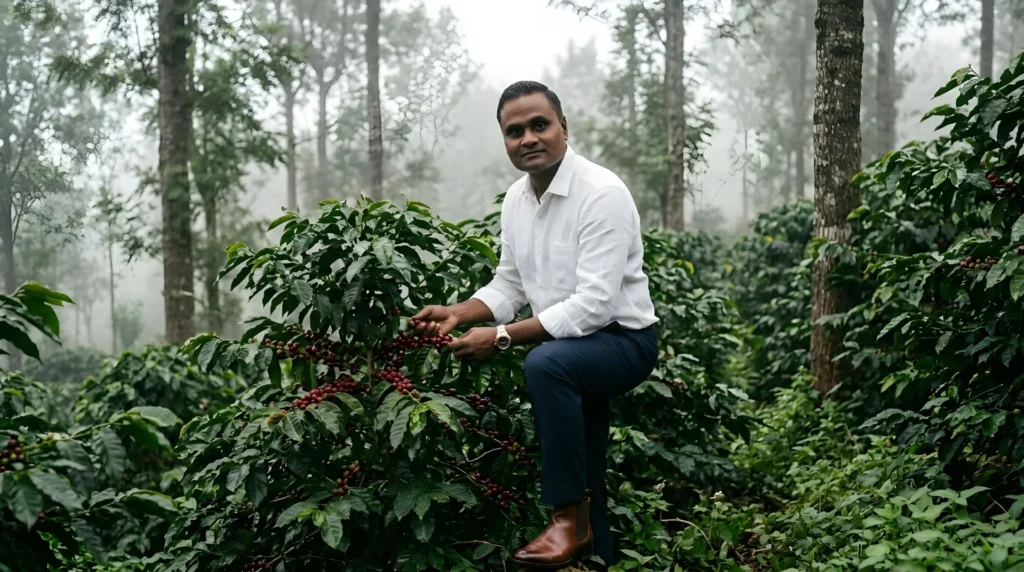
The NH-75 drive itself. You’re crossing the Western Ghats on a freshly four-laned highway. It’s not a commute. It’s a decompression ritual. One buyer described the experience as being “deep in the lap of mother nature” before they’d even reached the estate.
Four hours from traffic. Zero minutes from peace.
Practical connectivity goes beyond the drive. Hassan, the district headquarters, is 40 km away with hospitals, schools, and administrative offices. Sakleshpur has its own railway station on the scenic Hassan-Mangalore route. Mangalore International Airport sits 140 km away, about a three-hour drive. For NRI investors flying into Mangalore, Sakleshpur is the first premium hill-station corridor they hit.
Distance, for a farmland investment in Sakleshpur, isn’t the obstacle. It’s the filter. It keeps land prices grounded while Bangalore’s sprawl pushes Devanahalli and Kanakapura prices to 1.5-2.5 crore per acre. Sakleshpur stays accessible enough for weekend visits but distant enough to remain a genuine escape. That’s the balance most satellite investment zones can’t hold.
NH-75 Upgrade – Infrastructure That Drives Appreciation
Infrastructure timelines matter because land prices follow road quality. Here’s what’s happened on NH-75 in the last twelve months:
• Four-laning of Periyashanthi to BC Road section: completed November 2025 (NHAI EPC mode)
• Shiradi Ghat restoration works: inaugurated July 2025, targeting monsoon-proof connectivity
• New toll plaza at Bajattur: nearing completion
• Shanthigrama Toll Plaza near Sakleshpur: operational, 98%+ FASTag penetration
Looking further toward Bangalore, the Bangalore-Kolar section has a planned 10-lane corridor with six main lanes and four service lanes. That’s the kind of infrastructure spend that doesn’t happen for a corridor nobody expects to grow.
The historical pattern in Indian hill stations is clear: highway upgrades precede 2-5x land appreciation cycles. Ooty saw it after the Coonoor road widening. Lonavala saw it after the Mumbai-Pune Expressway. Sakleshpur’s NH-75 four-laning is the same signal.
The current land prices in Sakleshpur reflect a pre-infrastructure-premium market. That window is narrowing as each project milestone gets completed.
Smart City initiatives in Hassan district add another layer. District-level urban development tends to pull surrounding satellite towns into its growth orbit. Sakleshpur, at just 40 km from Hassan, sits squarely in that radius.
Tourism Growth – From Hill Station to Hospitality Hub
Sakleshpur and Hassan district record approximately 15 lakh annual leisure tourists, with leisure tourism growing at 25.5% CAGR from 2018-2024. Upcoming branded developments include a 160-key JW Marriott Plantation Resort and 75-key Dusit Devarana. Branded hotel inventory is projected to reach 50% of total supply by 2030, up from roughly 20% currently.
Let those numbers settle.
A 25.5% compound annual growth rate in leisure tourism over six years. That’s not a blip. It’s a structural shift in how Bangalore’s professional class spends its weekends.
The Prestige Group’s JW Marriott Sakleshpur Plantation Resort tells its own story:
• 99-hectare site
• 122 hotel keys + 38 hotel villas
• 40 branded residential villas (pre-launch phase)
• Conference center and spa village
Prestige doesn’t deploy that kind of capital on speculation. They’re reading the same growth data.
Dusit Devarana brings 75 keys. Tapovana The Fern Heritage Resort is already operational. The existing luxury inventory sits at 338 keys with another 358 mid-scale keys. And the farm-stay rental market is running at roughly ₹8,000 per night with 50% weekday and 100% weekend occupancy.
For Sakleshpur real estate, tourism growth isn’t just a lifestyle amenity. It’s an appreciation driver. Branded hospitality anchors raise land values in a radius around them. When JW Marriott opens, every estate within 10 km benefits. And for owners who want rental income in the interim, the farm-stay model is already proven. The 93-95% domestic tourist base, drawn primarily from Bangalore, Mysore, and Mangalore, creates consistent weekend demand that doesn’t depend on international travel seasons.
Sakleshpur vs Coorg & Chikmagalur – A Data-Driven Comparison
Sakleshpur offers coffee estate land at ₹25-47 lakh per acre compared to ₹60 lakh to 1.5 crore in Coorg and ₹40-80 lakh in Chikmagalur. At four hours from Bangalore versus six hours for Coorg, Sakleshpur combines lower entry pricing with stronger road infrastructure following NH-75’s four-laning completion.
Here’s the full comparison across eight parameters:
| Parameter | Sakleshpur | Coorg | Chikmagalur |
| Distance from BLR | 4 hrs (220 km) | 5-6 hrs (265 km) | 4.5 hrs (245 km) |
| Land price/acre | ₹25-47L | ₹60L-1.5Cr | ₹40-80L |
| Annual rainfall | 2,000-3,000mm | 2,500-3,500mm | 1,500-2,500mm |
| Coffee heritage | 150 yrs, Arabica + Robusta | 170+ yrs, Arabica dominant | 200+ yrs (origin) |
| Branded hospitality | JW Marriott 160-key incoming | Taj, Marriott existing | Taj incoming |
| Market saturation | LOW (emerging) | HIGH (saturated) | MEDIUM |
| Road infra | NH75 four-laned | NH275 (narrower) | NH73 (good) |
| Growth stage | Pre-appreciation | Mature / stabilizing | Mid-growth |
The thesis in one line: Coorg is what Sakleshpur will look like in ten years. But today, entry into Coorg costs 2-3x what Sakleshpur asks.
Chikmagalur sits somewhere in between. More tourism infrastructure, but higher saturation.
Sakleshpur is pre-appreciation. Coorg is post-appreciation. Chikmagalur is mid-cycle. For investors timing their entry, the math favors the emerging market with the strongest infrastructure momentum.
For a deeper look at pricing trends, see our analysis of current land prices in Sakleshpur. And if you’re weighing the tax benefits of agricultural land, Section 10(1) exemption applies equally across all three regions, but your per-acre entry cost in Sakleshpur means more acreage for the same capital.
Investment-Ready Estates in Sakleshpur
If Sakleshpur is the destination, what’s the vehicle?
Kaira by Vibez Estates is a 40-acre contiguous managed coffee estate in Sakleshpur. One estate. Three Paths:
• Managed Plots starting from 6,500 sq.ft – for investors who want coffee estate ownership without the farming learning curve
• Villa Plots from 3,500-8,000 sq.ft – for families building a weekend retreat
• Legacy Estates at 30,000 sq.ft – for institutional and family-office investors
The community already has 300+ investors. Vibez Estates has delivered 16+ projects since 2009 across over 1,000 customers. The estate includes a 5-star resort anchor with clubhouse, spa, and restaurant. Vernacular architecture. Biophilic pond. Plantation trails through working coffee rows.
For those evaluating managed farmland in Sakleshpur, KAIRA offers the managed model: you own the estate, the team farms it. Zero farming experience required. For buyers drawn to the coffee cultivation angle specifically, our coffee estate in Sakleshpur page walks through the product in detail.
Frequently Asked Questions About Investing in Sakleshpur
What is special in Sakleshpur?
Sakleshpur is a hill station in Karnataka’s Western Ghats at 3,000 feet elevation, known for a 150-year coffee heritage, 2,000-3,000mm annual rainfall, and proximity to Bangalore at four hours via NH-75. The region offers coffee estate investment at 30-40% lower land prices than Coorg, with emerging infrastructure including the JW Marriott Plantation Resort and completed NH-75 four-laning. The UNESCO-recognized Western Ghats biodiversity and year-round temperatures of 22-26°C make it distinct from drier investment corridors.
Which is better, Coorg or Sakleshpur for investment?
For entry-level land investment, Sakleshpur currently offers a stronger value position. Land prices run ₹25-47 lakh per acre versus ₹60 lakh to 1.5 crore in Coorg. The drive from Bangalore is two hours shorter. And Sakleshpur’s market is emerging rather than saturated. Coorg has more established tourism infrastructure, but that maturity is already priced into land. Sakleshpur’s NH-75 four-laning and incoming JW Marriott signal a growth trajectory similar to Coorg’s early years.
Which is better, Chikmagalur or Sakleshpur for investment?
Both are strong coffee regions with Western Ghats positioning. Sakleshpur has a proximity advantage at four hours versus four and a half from Bangalore, slightly lower land prices, and stronger road infrastructure with the recently four-laned NH-75. Chikmagalur has a more established tourism scene and is recognized as the origin of Indian coffee cultivation. For investors prioritizing entry pricing and infrastructure momentum, Sakleshpur offers better value in the current cycle.
What is the best area to invest near Bangalore?
Beyond Bangalore’s urban sprawl, Sakleshpur is emerging as a satellite investment zone four hours from the city. Unlike Hosur or Devanahalli which compete with urban pricing at ₹1.5-2.5 crore per acre, Sakleshpur offers agricultural land at ₹25-47 lakh per acre with coffee plantation income, tax-exempt agricultural returns under Section 10(1), and hospitality-driven appreciation. The trade-off is distance, but that distance is what keeps prices accessible.
What is famous to buy in Sakleshpur?
Sakleshpur is known for coffee estates, pepper plantations, and managed farmland. Investors purchase agricultural plots for coffee cultivation covering both Arabica and Robusta varieties, spice intercropping with pepper and cardamom, and long-term land appreciation. The region also offers opportunities in farm-stay development and properties adjacent to branded hospitality projects like the upcoming JW Marriott Plantation Resort.
Ready to Explore Sakleshpur’s Investment Potential?
Seven reasons. All grounded in data you can cross-check.
Sakleshpur’s combination of coffee heritage, climate advantage, Bangalore proximity, highway infrastructure, tourism momentum, and pre-appreciation pricing makes a case that no other Karnataka hill station can match at this entry point. Not Coorg. Not Chikmagalur. Not any of the drier eastern corridors.
300+ investors are already in. Vibez Estates has been operating in this corridor since 2009 across 16+ projects. The estate is 40 acres, contiguous, and managed.
Explore investment-ready estates in Sakleshpur
Managed farmland in Sakleshpur | Coffee estate in Sakleshpur